Commercial Field Trial /
Terragen Probiotic for Ruminants
Lambs
Agriculture Victoria Research / Hamilton SmartFarm, VIC
In a recent study, Terragen Probiotic for Ruminants lowered methane intensity by 30% and improved average daily liveweight gain by 24%
Globally, the livestock industry produces approximately 7.1 gigatonnes of CO2 equivalents of greenhouse gases (GHG) per year, around 14.5% of total GHG emissions. Within this sector, enteric methane production by ruminants is the greatest contributor, representing 71% of emissions from livestock.
Direct-fed microbials (DFM) offer a ustainable and easily acceptable solution to help reduce enteric methane emissions from ruminants, while providing productivity benefits without challenges to product integrity.
This research was part of the Australian government’s ‘Methane Emissions Reduction in Livestock’ (MERiL) round 2, led by Agriculture Victoria Research at their Hamilton SmartFarm between February and June 2024. The DFM used was a freeze-dried formulation of Terragen’s Lactobacillus product, Terragen Probiotic for Ruminants, due to be launched with the new name of Terragen Probiotic for Ruminants.
The objective of this study was to determine whether feeding lambs Terragen Probiotic for Ruminants would improve lamb performance (liveweight gain, body composition, carcass yield) while also reducing methane production (g/day) and intensity (g/kg liveweight). Improving these parameters not only leads to a positive return on investment for the customer, but also supports sustainable production systems, reducing the impact on the environment.
STUDY AIM: To determine whether feeding lambs Terragen Probiotic for Ruminants (TPR) would improve lamb performance while also reducing methane production and intensity.
After 70 days of feeding, the lambs fed TPR had
24% higher
average daily liveweight gain (p<0.05) and methane intensity was
reduced by 30
(p<0.05)
_ STUDY DESIGN
One-hundred lambs were selected from a mob of terminal sired 2023 drop lambs born from maternal composite ewes in July 2023. The selected lambs were either single-born or twin born with a live weight of greater than 25 kg at weaning.
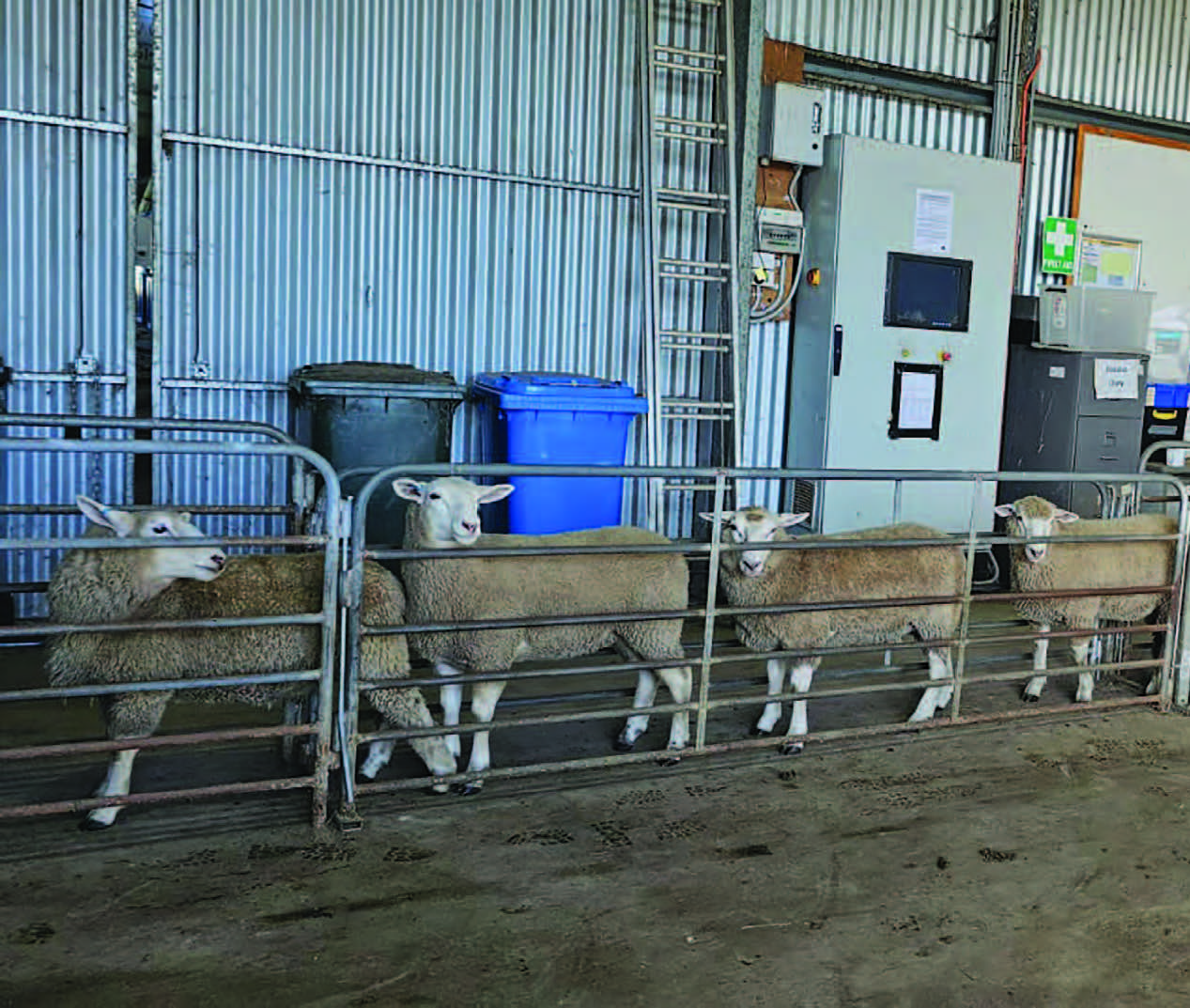
Lambs were drenched and vaccinated with 5 in 1 prior to the experiment. The lambs were fed a vetch hay and adapted to the experimental grain mix over 14 days before being introduced to the C-lock Super SmartFeedTM automated supplement feeder over the next 21 days. Following this adaptation period, 68 lambs that adapted to the feeder were selected to continue the experiment. The SmartFeeder uses the sheep RFID ear tags to identify individual lambs and in turn dispense the feed allocated for each day according to their assigned treatment.
The 68 lambs were then randomly allocated into two groups: a control group (34) (Control) and a treatment group (34) (Terragen Probiotic – Ruminant). The freeze-dried TPR contained 5.0 x 10¹² CFUs/500 g mix, delivering 1 x 10¹¹ CFU / kg feed.
The lambs were fed their respective rations for 70 days. The daily requirement of TPR was mixed with the daily grain allocation using a rotary mixer, then dispensed into the SmartFeeder. Initially the level of grain offered was set at 450 g/head/day and this was increased over a 14-day period. The total amount of grain offered was adjusted to achieve growth rates of ~ 200 g/day and to reach a target weight at slaughter of 45-55 kg. Levels of the supplement were set to target ~ 50% of the expected daily feed intake at the start of the training period and adjusted every 2-4 days until the target rate was attained.
_ DATA COLLECTION
Gas measurements
Methane (CH4), carbon dioxide (CO2) and oxygen (O2) were measured on day 31, 59 and 71 of the study, using portable accumulation chambers (PACs).
Live weight and carcass measurements
Lambs were individually weighed and condition scored on a weekly basis during the study. An additional liveweight measurement was also recorded immediately prior to methane measurements.
Fat depth and eye muscle diameter (EMD) were measured using ultrasonography at both the start and end of the experiment. A pre-slaughter liveweight (curfew weight) was recorded after a 12-hour curfew from feed and water prior to transport for slaughter at a commercial abattoir. Hot carcass weight of each carcass was measured at approximately 1 h post-mortem and dressing percentage was calculated using the pre-slaughter live weight and hot carcass weight.
_ RESULTS & OBSERVATION
The average daily weight gain and body condition score of the lambs are provided in Table 1.
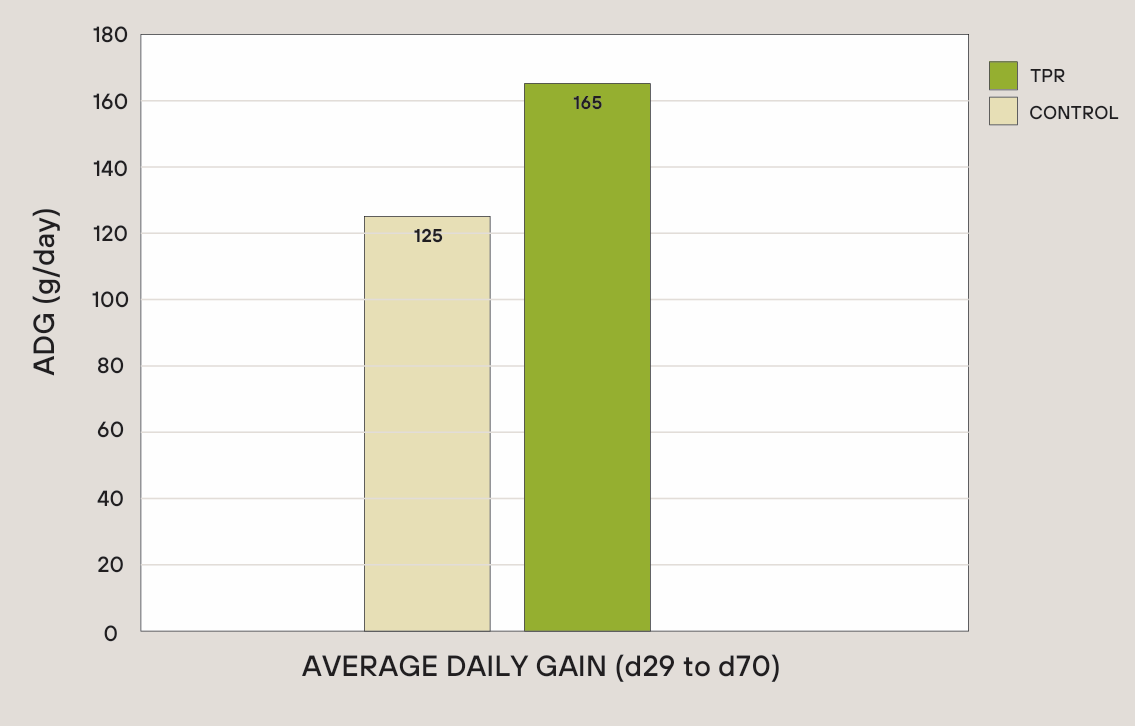
Following adaptation to dietary regimes (days 1-29), feeding lambs the TPR supplement improved liveweight gain per day and body condition score. The average daily weight gain (ADG) from day 29-70 was 24% greater in the TPR group compared to the control group (P=0.009), and this corresponded to a 25% higher total live weight change in the TPR group (P=0.009). Additionally, the body condition score (BCS) at the end of the experiment was higher in the TPR group (P=0.034). The fasted live weight, measured 12 hours after fasting, at the end of the experiment, was also higher in the TPR groups compared to the control groups (P=0.028).
Table 1: Effects of feeding Terragen Probiotic for Ruminants (TPR) on production performances of lambs
| Control | TPR | SED1 | P-value | |
|---|---|---|---|---|
| n | 34 | 34 | ||
| Start BW2 (kg) | 42.2 | 42.0 | 0.47 | 0.643 |
| End BW (kg) | 52.1 | 53.6 | 0.38 | 0.079 |
| Total BW Change (d1 to d70) (kg) | 9.8 | 11.6 | 0.91 | 0.044 |
| BW Change (d29 to d70) (kg) | 5.2 | 6.9 | 0.63 | 0.009 |
| ADG3 (d1 to d70) (g/d) | 140 | 166 | 13.0 | 0.044 |
| ADG (d29 to d70) (g/d) | 125 | 165 | 15.0 | 0.009 |
| Curfew BW | 49.9 | 51.8 | 0.85 | 0.028 |
| Start BCS4 | 3.5 | 3.5 | 0.04 | 0.712 |
| End BCS | 4.1 | 4.2 | 0.06 | 0.034 |
| Total BCS Change | 0.5 | 0.7 | 0.05 | 0.019 |
(1 SED = standard error of the difference between treatments, standard error of the mean;
2BW, body weight; 3ADG, average daily gain; 4BCS, Body Condition Score)
Average Daily Gain g/day) from day 29 to day 70 of lambs in control group compared to the TPR group
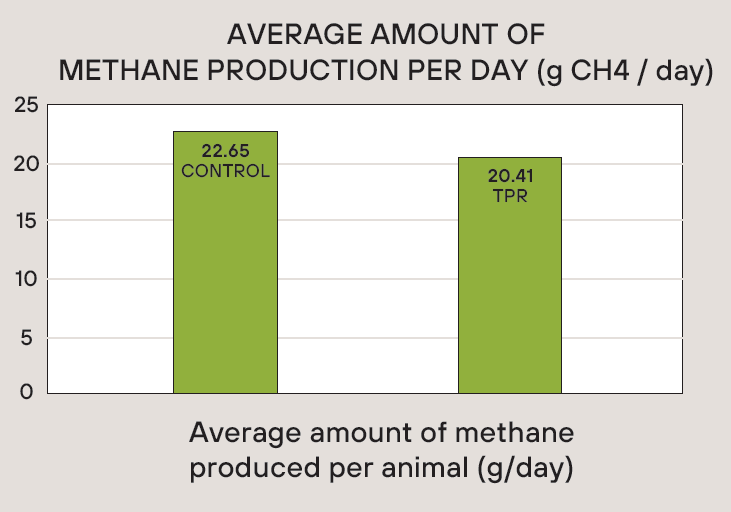
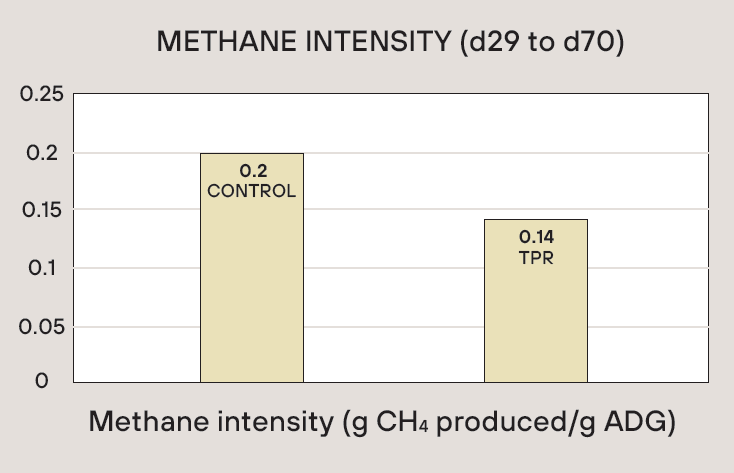
Methane production (g/d) and methane intensity (g/g ADG) from the lambs areprovided in Table 2.
Lambs consuming TPR showed 9.9 % lower methane production, when compared to those consuming the control feed (P=0.095). In the third measurement period, methane production in the TPR group was 14 % lower compared to the control group (P=0.047), with a notable decrease observed from the first measurement period. The methane intensity was 30 % lower in the TPR group when compared to the control group (P=0.008).
Table 2: Effects of diet on methane production (g/d) and methane intensity (g/g ADG)
| Control | TPR | SED1 | P-value | |
|---|---|---|---|---|
| n | 34 | 34 | ||
| Methane production (Day 31) | 23.8 | 22.4 | 2.49 | 0.569 |
| Methane production (Day 59) | 21.2 | 19.7 | 2.00 | 0.468 |
| Methane production (Day 70) | 22.3 | 19.3 | 1.52 | 0.047 |
| Average Methane production | 22.65 | 20.41 | 1.318 | 0.095 |
| Methane intensity (d29 to d70) | 0.2 | 0.14 | 0.022 | 0.008 |
(1 SED = standard error of the difference between treatments)
These results are promising, indicating that Terragen Probiotic for Ruminants could be a viable and sustainable approach for methane mitigation in sheep in the future, while also increasing daily weight gain.
_ CONCLUSION
Supplementing the diet of lambs with Terragen Probiotic for Ruminants (TPR) significantly increased the average daily weight gain in growing lambs. While methane production was numerically lower in the TPR supplemented group compared to the control, methane intensity was significantly lower for the TPR supplemented group.
A Lactobacillus DFM fed to growing lambs on a legume hay-based diet effectively lowered methane intensity and improved animal performance over a three-month continuous feeding period. Future research could
investigate the impact of this supplement on adult sheep raised for meat production, assessing its long-term benefits and broader applicability for methane mitigation and improved animal performance.