Independent Field Research Data
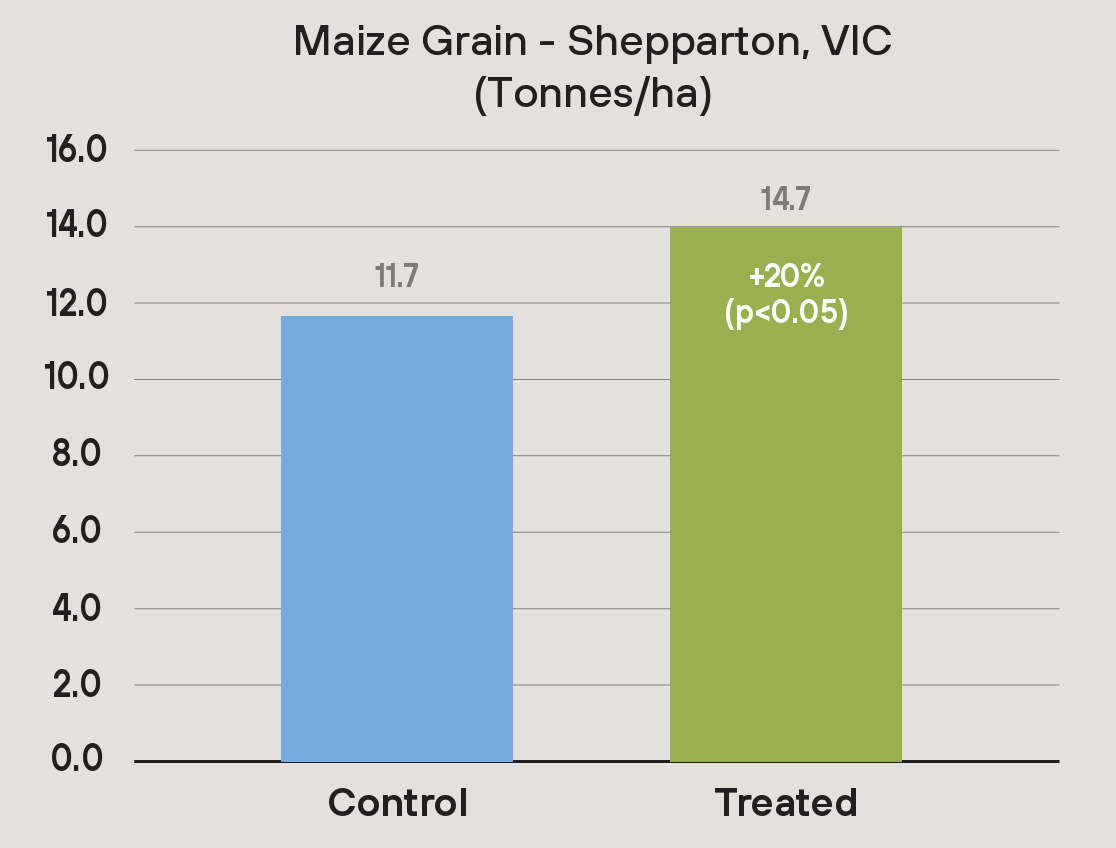
Maize Grain – Replicated Trial, Shepparton, VIC
Independently Conducted by Ag Logic# (July 2016)
Aim: Determine the effect of Great Land on maize grain yields and plant growth parameters.
Design: Randomised field trial, five (5) replicates of equal area for each treatment.
Treatment areas 1.0 ha each. Same soil type, flat topography, agronomic practices across all treatments.
Fertiliser over season: 354 kg N/ha; 60 kg P/ha; and, 5 kg S/ha.
Treatments:
Treatment: Great Land® @ 20* L/ha undiluted at sowing (Nov-15) injected directly with seed, same depth. Fertiliser program same as control except no starter applied to treated replicates.
Control: No Great Land® applied. Standard fertiliser program, including starter (30L/ha).
Assessments: Grain yield – harvested (Apr-16) by the grower using a GPS based yield monitor logging at a rate of once per second (every 2 metres). Monitor related variability at the ends of each row were removed from data before analysis.
Plant growth measured during vegetative stage: NDVI imaging, plant height, stem diameter. Grain nutrient content analysed – elemental and feed quality.
Results: Replicates treated with Great Land® yielded an average of 2.3 t/ha of grain (moisture 13%) more than control strips, representing 20% better yield performance. Superior uniformity of yield was achieved across Great Land® treated replicates, ranging from 13.6 to 14.2 t/ha, compared to control replicates ranging from 10.3 to 13.3 t/ha.
Plant growth during vegetative stages and nutrient content of grain did not show significant differences between Great Land® treatment and control.
Conclusions:
The trial demonstrates a benefit from using Great Land® to enhance maize grain yields.
On the basis of $270/tonne grain price and the cost of Great Land® application, an incremental gross margin of $537/ha is recorded for the trial area.
# Ag Logic Agricultural Intelligence. Newstead, TAS. | www.aglogic.com.au | Full report available on request.
* Trial application rate equivalent to new Great Land formulation, released December 2018
| Trial 1: Input Applications | Control | Treated | Units |
|---|---|---|---|
| Great Land®: in furrow with the seed | 0 | 20* | L/ha |
| Great Land®: surface spray, 3 weeks post sowing | 0 | 10* | L/ha |
| Fertiliser Program: | |||
| Base: DAP | 300 | 150 | kg/ha |
| Urea | 300 | 200 | kg/ha |
| Started | 30 | 0 | L/ha |
| Fertigation thru season – Urea | 300 | 300 | kg/ha |
An incremental gross margin benefit of $217 per ha (6.4%) was achieved calculated on the basis of prevailing grain prices and inputs costs at the time of harvest.
Trial 2
Aim: To determine the effect of Great Land and lower base fertiliser application on grain yields.
Design:
- Replicated field trial, six (6) strips (replicates) for each treatment and control.
- Strips 580m long x 6m wide (one seeder width). Area 0.35 ha per strip, 4.2 ha total trial area.
- Same soil type, flat topography and agronomic practices across all treatments.
- Flood irrigated system. Crop sown late-Nov 2016, harvested mid-May 2017
Treatments:
Treated strips received two Great Land applications and lower base fertiliser:
- DAP reduced by half
- Urea by one third
- Starter fertiliser to nil
Remainder of season urea was the same for treatment and control.
Results: Replicates treated with Great Land had an average yield of 12.98 t/ha (wet weight), compared to control replicates averaging 12.55 t/ha – a difference of 0.43 t/ha (3.4%). The uniformity between treated replicates was considerably better than that of the control, rendering the difference in average yield as statistically significant (p<0.05).
Comment: The trial provides evidence of Great Land’s contribution to enabling less reliance on conventional fertilisers, thereby achieving positive gains in profitability while contributing to improving sustainability of soil health.
Trial 2
Aim: Determine the effect of Great Land on maize grain yield.
Design:
- Same as Trial 1.
- Flood irrigated system.
- Same maize cultivar was used in Trial 1 and Trial 2.
Treatments:
Great Land applied in the furrow with the seed at 20L/ha*. Great Land replaced ‘Starter Fert’ at sowing. No further applications after crop emergence. Fertiliser applications were the same across all treated and control strips (as per standard rates in the control strips of Trial 1 above).
Result: Great Land treated replicates averaged 0.13 t/ha (1%) more yield than untreated control. Average yields were 12.72 t/ha for treated strips and 12.59 t/ha for control strips. Yields of treated replicates were, again, considerably more uniform than yields between control replicates.
Comment: Combining this result with other separate trials in the same district, evidence indicates that a single Great Land treatment in-furrow with the seed produces inconsistent outcomes. A post emergence application approximately 2-3 weeks after sowing is likely to achieve better yield results.
* Trial application rates equivalent to new Great Land formulation, released December 2018