
The aim of this trial was to determine the effect of a commercially available DFM containing three strains of Lactobacillus bacteria (MYLO®, Terragen Biotech, Australia) on the liveweight gain, ADG and FCR of steers in a feedlot.
Lot feeding plays an essential role in maintaining and growing the domestic and international consumer market for quality beef year-round. Challenges in lot feeding include maximising animal health and productivity results amidst pressures to reduce antibiotic and chemical usage and minimise environmental impact. Direct fed microbials (DFMs) have emerged as a potential solution offering enhanced performance and improved health outcomes, without the risk of residues.
The objective of this study is to investigate the impact of a DFM (MYLO®) on liveweight gain, average daily gain (ADG), feed conversion ratio (FCR) and health outcomes in feedlot cattle. ADG and FCR are key metrics representing the amount of daily weight gain and the amount of feed required to produce a unit of weight gain respectively. Improving these metrics enhances profitability through reduced feed costs while also minimising potential environmental impact. The findings of this study could have significant implications for the livestock industry, as DFMs may provide a natural and sustainable means of improving the productivity of feedlot cattle.
After 92 days, treatment animals were 6.2 kg heavier than control (p<0.05) and had a 4.8% higher Average Daily Gain.
Study design:
A commercial feedlot near Finley, NSW with a license for 9999 head was engaged for this study. This feedlot is NFAS accredited and has operated for 18 years.
A total of 283 friesian and friesian cross steers from three different background environments (group 1: pellets, group 2: mixed cohort and group 3: grass fed) were randomly split into two equal groups (treatment and control) by feedlot managers. Animals weighed from 262kg to 486kg on entry to the trial, with the treatment group averaging 336.3kg and the control group averaging 335.6kg.
All animals received treatments in line with the standard induction protocol including: anthelmintic drench, 5-in-1 vaccination, Multimin® injection and Bovilis® vaccination. The steers were identified with visual tags corresponding to electronic identification devices (EIDs) and also marked with a coloured ear tag to visually differentiate treatment and control groups.
The treatment group animals were supplemented with MYLO® at a rate of 30mL/hd/day mixed in with the standard transitional ration from day 1 to day 21. On completion of transitional ration (from day 22), the rate of supplementation was decreased to 10mL/hd/day. Control animals were given the same rations, without the inclusion of MYLO®
Data collection:
Individual liveweights were recorded on commencement of the trial (day 0), on completion of the transitional period (day 21), half way through finishing (day 57) and on completion (day 92) – data from the two mid-trial weight recordings is not shown here. Individual weights were recorded using electronic scales linked to a TruTest system which correlated recorded weight to individual EID.
Total ration given to each pen was recorded on a daily basis, allowing an average daily intake (kg/hd/day) to be calculated. Morbidities and mortalities were monitored and recorded as required on a daily basis.
Results & observation:
Individual weights were recorded, however are reported on group average and then as an overall average across the trial period. Liveweight gain, variance, ADG and FCR are reported in the table below (Table 1). Overall, average liveweight gain across the groups ranged from 126.27kg through to 163.24kg across the trial period.
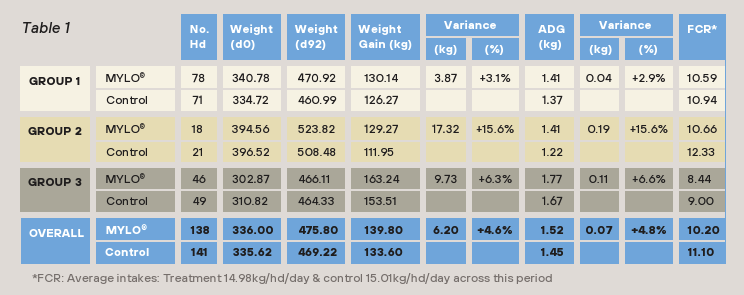
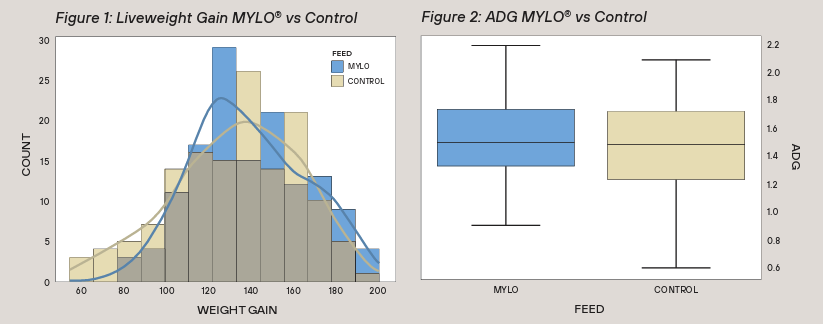
Treatment animals performed better across all metrics in all groups. When comparing overall results over 92 days, treatment animals were 6.2 kg heavier than control (p<0.05) and had a 4.8% higher ADG (1.52 kg/day v 1.45 kg/day; p<0.05). There was no difference in FCR between treatment and control groups. There was no variance between groups when it came to morbidity and mortality percentages, which were exceptionally low.
Trial Results
Supplementing feedlot steers with MYLO® improved liveweight gain and ADG. MYLO®’s impact on steers from different backgrounds varied, which may be due to diet (and pre-existing rumen microbiota) at the time of entering the feedlot. Further studies are required to determine if the improvement in weight gain persists over longer periods of time in the feedlot and if there is a dose-dependent effect of MYLO® on weight gain.