
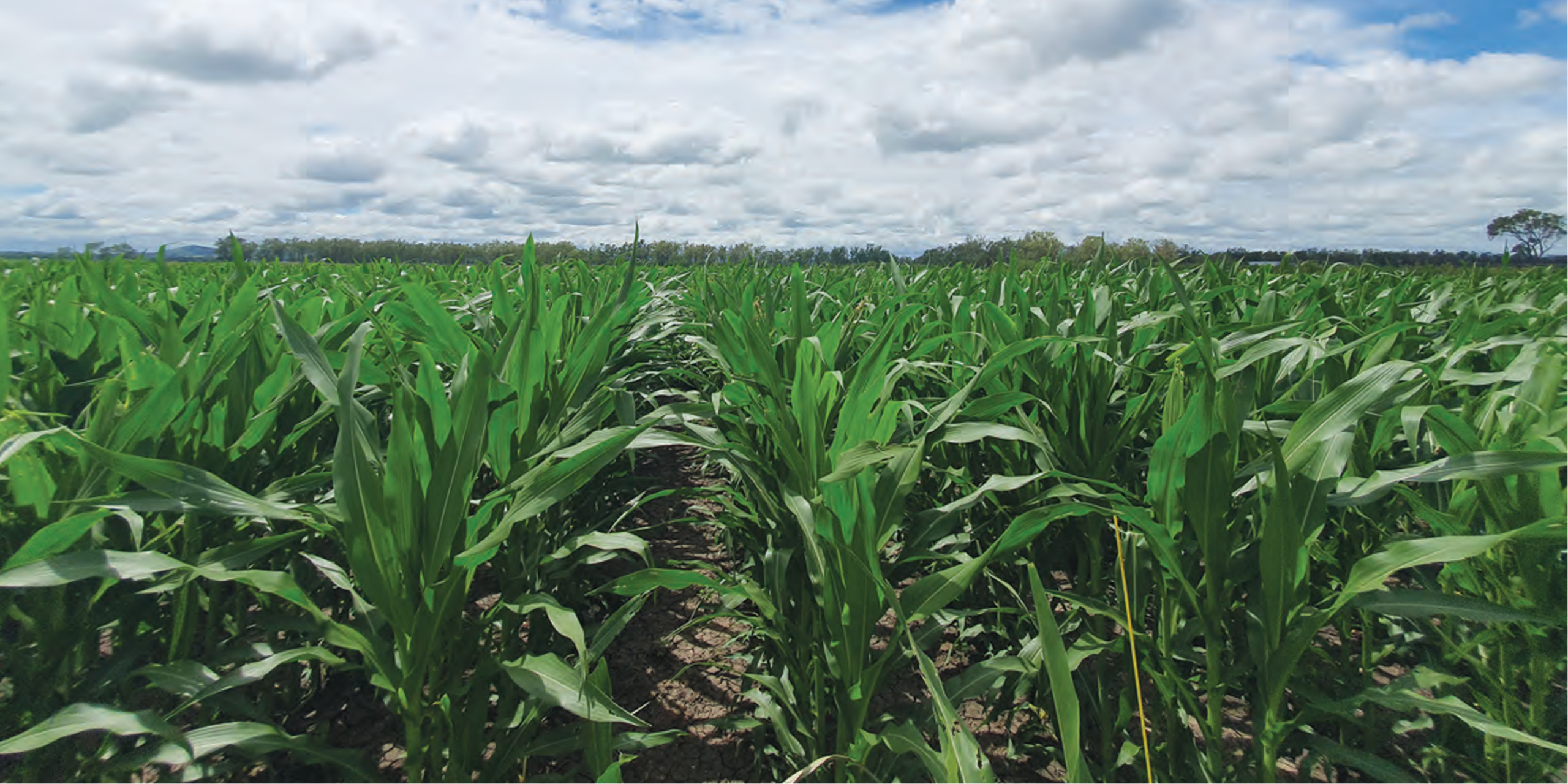
This research aims to explore the use of Great Land Plus® in Maize to manage crop productivity while reducing the amount of synthetic fertilisers.
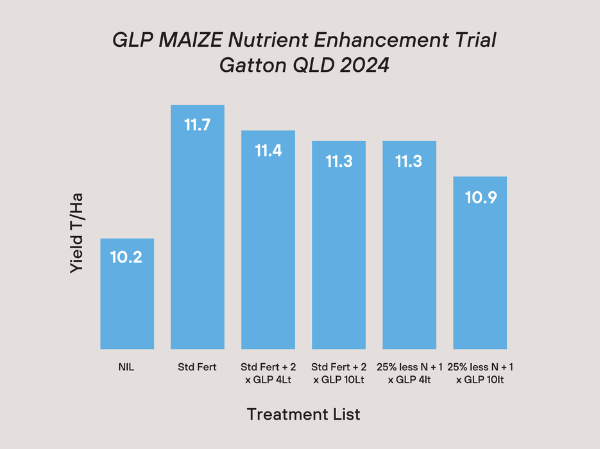
This research explores the use of GLP in maize at two application timings, in furrow and early crop emergence, with full rate of fertiliser and 25% reduced fertiliser.
Trial was conducted by independent research organisation in Eurofins/Kalyx.
Trial Site Overview
Sown: 16th October 2024
Harvested: 4th March 2025
Rotation Position: Fallow 2023 & 2022
Variety: Pioneer P2307
Standard Fertiliser: Urea, Sulphate of Potash & Granulock Supreme Zn
Objectives
To test the hypothesis that using Great Land Plus® can support reduced requirement for synthetic fertilizer inputs while maintaining crop yield and improving plant health and uniformity.
Test the application timing of plant bio-stimulant Great Land Plus® and its effect on crop growth and yield.
Support data driven recommendations for sustainable agriculture practices using Great Land Plus®
Trial Methodology
Location: Gatton QLD
Duration: Conducted in the 2024/25 season starting 16th October and finishing 4th March 2025
Experimental Design: Randomized complete block
Key measures: Crop Yield, Biomass, Plant leaf nutrients and available soil nutrients
Trial Results
Treatment Number and Application
- NIL – No treatments
- Standard Fertiliser – 350kg Urea, 100kg SOP, 40kg Granulock S Zn
- Std Fert plus 2 x 4L GLP (In furrow & 4 WAS)
- Std Fert plus 2 x 10L GLP (In furrow & 4 WAS)
- 90kg less Urea 1 x 4L GLP (4 WAS)
- 90kg less Urea 1 x 10L GLP (4 WAS)
Key Points:
- Site was responsive to fertiliser treatments
- Yields ranged from 10.2 – 11.7 t/ha with (p=<0.006)
- Treatment 5 – 90kg less urea had highest ROI of all GLP treatments and yielded consistently across all 6 replicates with only 0.04 variance
- Treatment 5 – represents a $40/ha input saving over standard fertiliser program
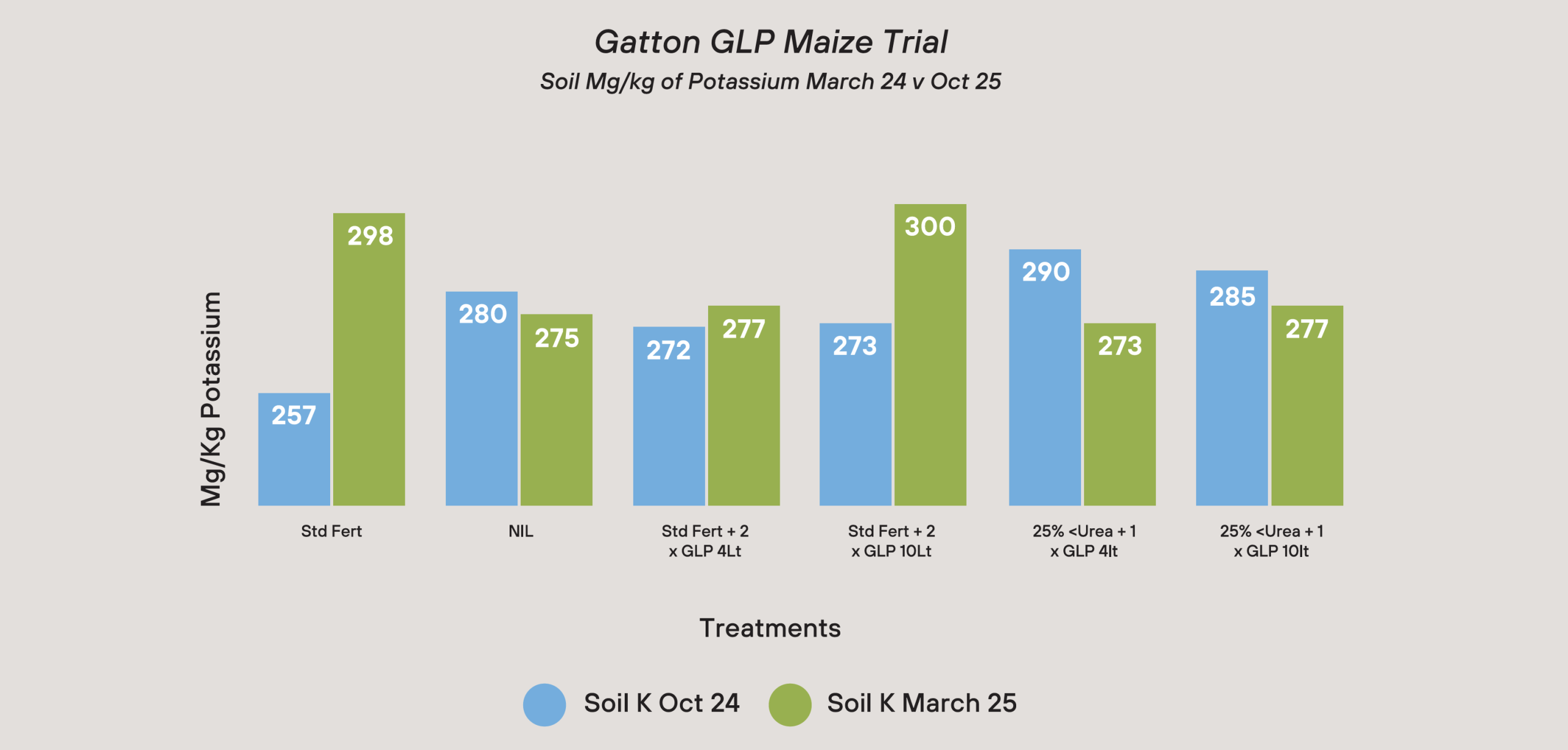
- While no significant differences in available soil potassium between treatments, both standard fertiliser treatment and GLP in furrow treatments had higher available K at harvest March 2025
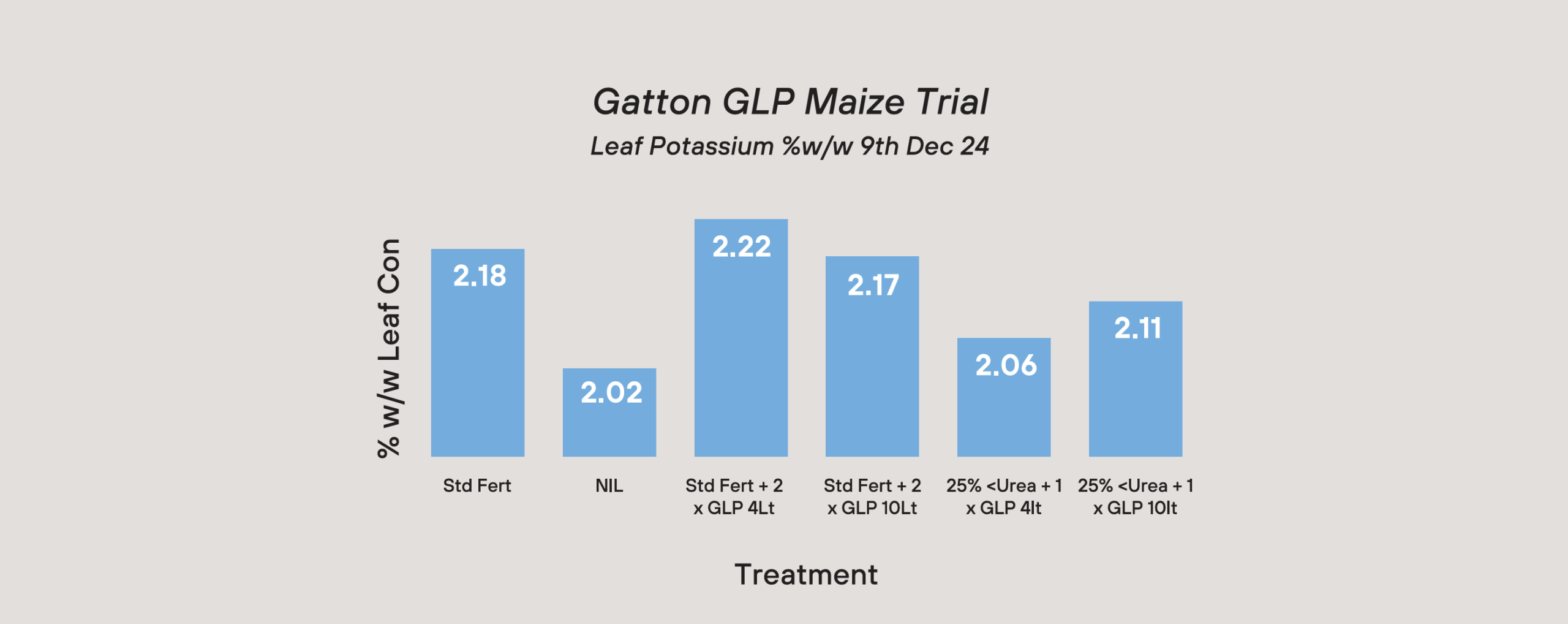
- Significant difference in leaf concentration of K at 9th Dec with Treatment 3, with 4L of GLP in furrow and 4 WAS being the highest. (p=<0.003)
- All treatments had significant differences over NIL treatment
- Treatments 5 & 6 with 25% less fertiliser had significantly higher concentrations of Moly v all other treatments
- 3 GLP treatments had higher leaf manganese concentrations over standard fertiliser treatment
- No significant difference for Copper and Boron v Standard Fertiliser treatment
Key Points
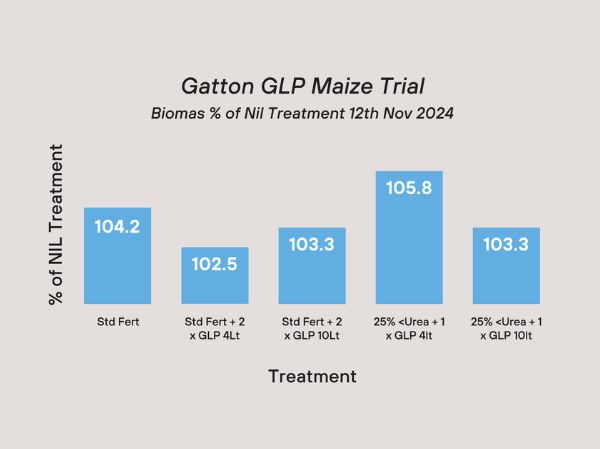
- 27 Days post sowing significant differences in crop biomass over untreated (p=<0.02)
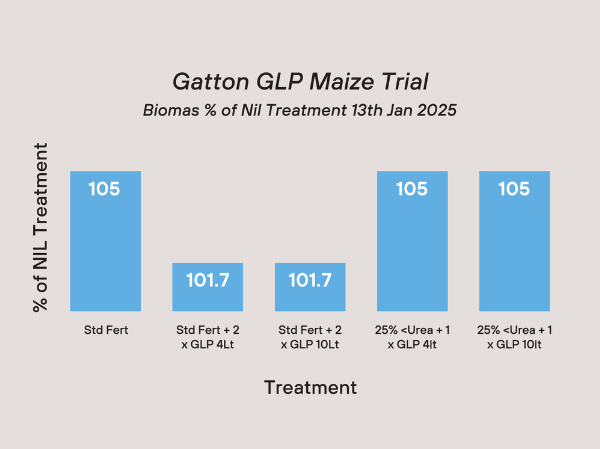
- 89 days post sowing treatments 5 & 6 with 25% less fertiliser equal biomass to standard fertiliser treatment
- Significant % difference of green leaves across all treatments versus nil control (p=<0.001)
- Kalyx contractor noticed GLP treatments staying greener for longer prior to harvest
Trial Leaf Concentration Micro Nutrients
| Trt Name | Leaf Manganese mg/kg | Leaf Molybdenum mg/kg | Leaf Boron mg/kg | Leaf Copper mg/kg |
|---|---|---|---|---|
| Std Fert | 65 bc | 0.81 ab | 23 a | 10.3 a |
| NIL | 62 c | 0.72 b | 18 b | 8.9 b |
| Std Fert + 2 x GLP 4Lt | 73 ab | 0.79 ab | 23 a | 10.5 a |
| Std Fert + 2 x GLP 10Lt | 74 a | 0.79 ab | 24 a | 10.0 a |
| 25% <Urea + 1 x GLP 4Lt | 70 abc | 0.89 a | 23 a | 10.3 a |
| 25% <Urea + 1 x GLP 10Lt | 65 c | 0.85 a | 22 a | 10.2 a |
| LSD p + 0.05 | 8 | 0.106 | 3.4 | 0.83 |
| P val | 0.03 | 0.04 | 0.009 | 0.008 |
Table 1. Influence of GLP on leaf concentrations of micro-nutrients – 9th December 54 days after first application and 11 days after 2nd application.
Summary
Objective
To test the hypothesis that using Great Land Plus® reduces requirement for synthetic fertiliser inputs while maintaining crop yield and improving plant health and uniformity.
Key Finding
- Reduced Fertiliser Dependency: A 25% reduction in fertiliser use can be achieved without compromising crop performance when GLP is included in the program.
- Optimal Application Timing: A single application of 4L of GLP 4 weeks after seeding resulted in the greatest ROI compared to standard fertiliser programs.
- Sustainability Benefits: This method enhances nutrient efficiency, lowering input costs while maintaining yield potential.
Conclusion
Incorporating GLP into fertiliser programs presents a promising approach for maize growers seeking cost-effective and sustainable nutrient management solutions. Further trials may explore long-term soil health benefits and broader scalability.
Thanks to Matt Burley trial investigator from Eurofins/Kalyx.
For further information regarding the trial please contact Terragen Business Development Manager – Plant Bio-stimulants
Graham Page | E: grahamp@terragen.com.au | P: 0418 849 892